
Trail to the Future
A bike ride through Northern Virginia's data center alley

A year ago this month, my husband, Tim, and I bought Cannondale gravel bikes, and we became semi-regulars on the local railroad-turned-bike trail called the W&OD, or Washington & Old Dominion. The 45-mile route traverses Northern Virginia’s suburbs, beginning in Shirlington, just across the Potomac River from Washington, and ends in Purcellville, a small town in the foothills of the Blue Ridge Mountains.
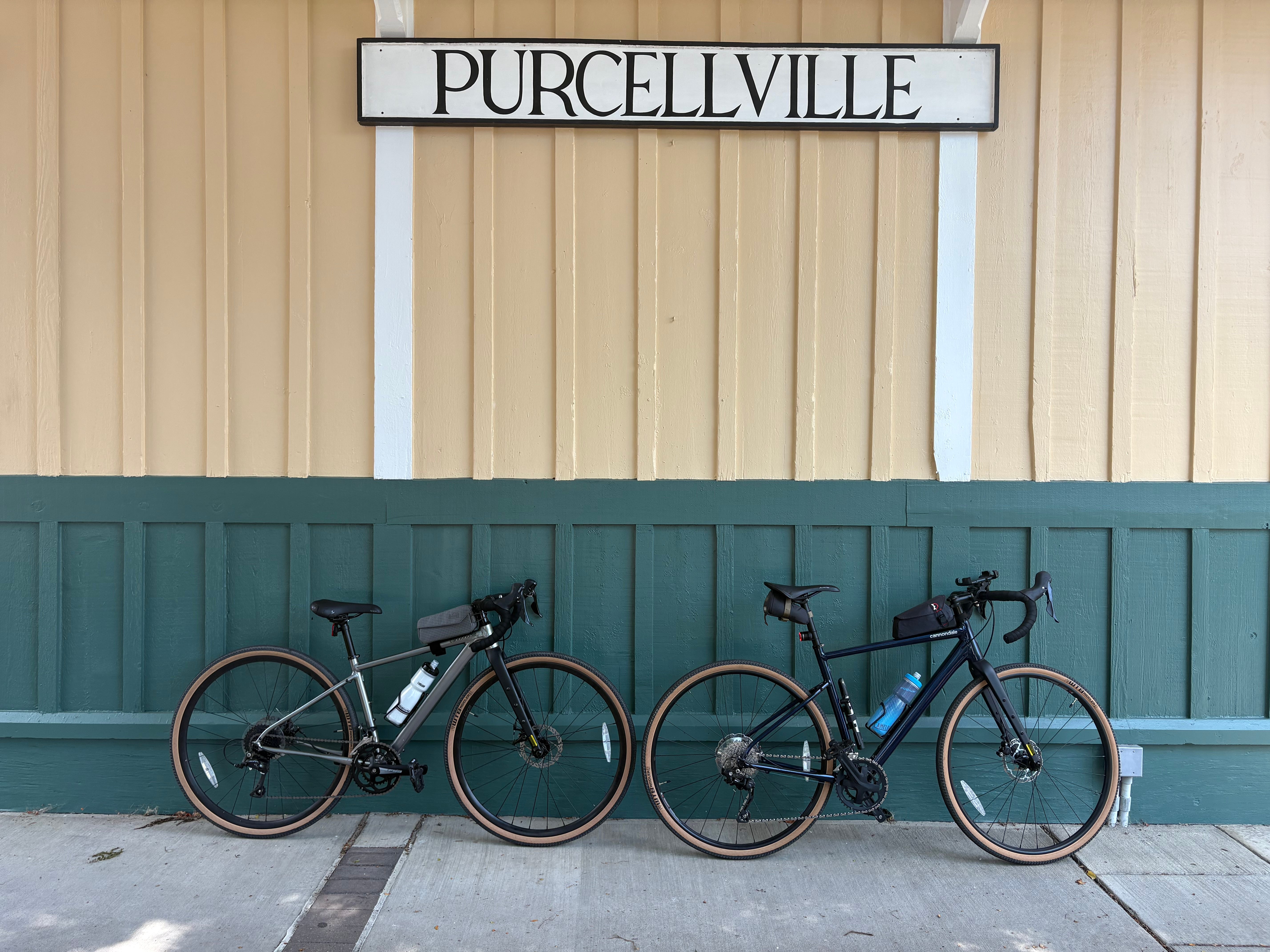
I love the perspective you gain along a bike trail. An intersection you’ve driven through dozens of times in a car looks different from the vantage point of a bike. Woods you’ve only ever seen from the road come to life when you pedal on a trail surrounded by them. It can be disorienting, like you don’t recognize a place you know so well when you look at it from a new angle.
When I was a kid, my family and I would ride the Little Miami Scenic Trail in Cincinnati, Ohio. Cycling through Indian Hill, the city’s wealthiest suburb, made it easier to get a look at the palatial gated mansions that were difficult to see from the road. The homes fascinated me: the size, the driveways, the architecture. On the trail, I could quickly peek in a few backyards while we pedaled by. A child’s toy laying used in the grass. Bushes in need of landscaping. A trash bag waiting for pick up. Out-of-place details made me realize the people who lived in these massive houses were human, too.
It was a new perspective.
Tim and I live in Ashburn, near the midpoint of Virginia’s W&OD. When the bike trail was a railroad, Ashburn was a rural community known for its dairy farms. Today, it is known for being the data center capital of the world. Over 70% of the world’s internet traffic flows through Ashburn’s 100+ data centers.
Data centers are gigantic, windowless buildings, home to rows and rows of servers and computer equipment. From credit card transactions, to hospital records, to Amazon purchases, everything online runs through buildings like these, mostly in Northern Virginia for now, but expanding almost everywhere, especially in the race toward artificial intelligence. President Trump recently signed an executive order to rollback regulations and fast track the construction of data centers.
Last year, I did a story on data centers for Fox News and how they are straining the power grid. There’s a statistic from that story that I can’t get out of my head: a single data center built for artificial intelligence needs one gigawatt of electricity, or roughly the same amount of power generated by an entire nuclear power plant. But the situation has only worsened since then.
A report commissioned by the state of Virginia in December 2024 says that “building enough infrastructure for unconstrained data center demand will be very difficult and meeting half that demand is still difficult.” New energy sources, like solar farms, would have to be built twice as fast. Natural gas plants would have to be added to the power grid more quickly than ever before.
PJM, the company that coordinates the power grid for 13 states in the Eastern U.S., has raised the alarm this summer about continuing power supply issues. They blame “permitting timelines, supply chain constraints and evolving project economics” for stalling energy projects, and have passed the cost of the A.I boom onto the ratepayers. There are reports that soaring electricity demand is threatening power outages while industry consultants like McKinsey are planning to build “bigger, faster, and cheaper” data centers and says that the U.S. will have to "more than triple” its annual power capacity over the next five years.
Think about the domino effect of this. It’s not just about the data centers, which require a tremendous amount of space, infrastructure, power, and water. But hundreds of thousands of acres of farmland will get turned into solar farms. Power plants from nuclear to natural gas will go up in communities across the country. Transmission lines will run over neighborhoods. All while the government is rushing the projects through at any cost, maybe even with the use of eminent domain. It’s not that crazy. JP Morgan Chase CEO Jamie Dimon suggested it a few years ago before the situation was this dire.
Here in Ashburn, we already know what this future looks like. Look at the drive to one of our W&OD trailheads.
In a way, the W&OD has always been about advancement. First, it was a railroad, considered the epitome of progress for America in the 1800’s. Then, railroads became increasingly obsolete with the introduction of the car, and by 1968, the W&OD took its last train ride. And now, as the era of A.I. dawns on us, the view from the railroad-turned-bike trail can show us a new perspective.
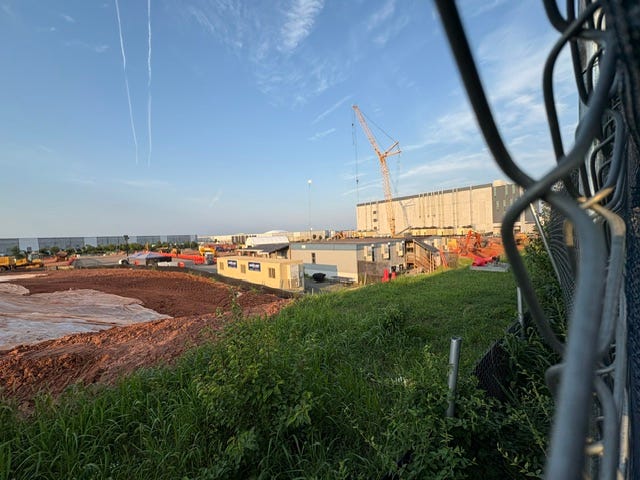
Ashburn, originally named Farmwell, has rural roots. During the time of the W&OD railroad, Ashburn’s dairy farms supplied Washington with fresh milk.
Things started to change in the 1960’s. Dulles Airport was built in neighboring Sterling. The government began experimenting with early forms of the internet in Northern Virginia. Dairy farms started to go out of business. In 1985, Loudoun County gave developers approval to build a planned community called Ashburn Village within its town limits, the first of many. By the late 1990s, the early internet infrastructure and proximity to Washington created the perfect environment for data centers.
Newspapers tried to cover the transition. “In Ashburn, a dividing line between pasture and future” wrote the Washington Post in 1996. “Village store resists a modern arrival” in 1998.
Today, all signs of what Ashburn was are definitely gone. The original farms and farmhouses were sold, eventually razed, and made into housing developments or strip malls. The old Partlow’s Store, now Carolina Brothers BBQ, was a general store that dates back to the 1930’s. Today, it sits alongside the W&OD trail and is one of the last-standing symbols of the original Ashburn.
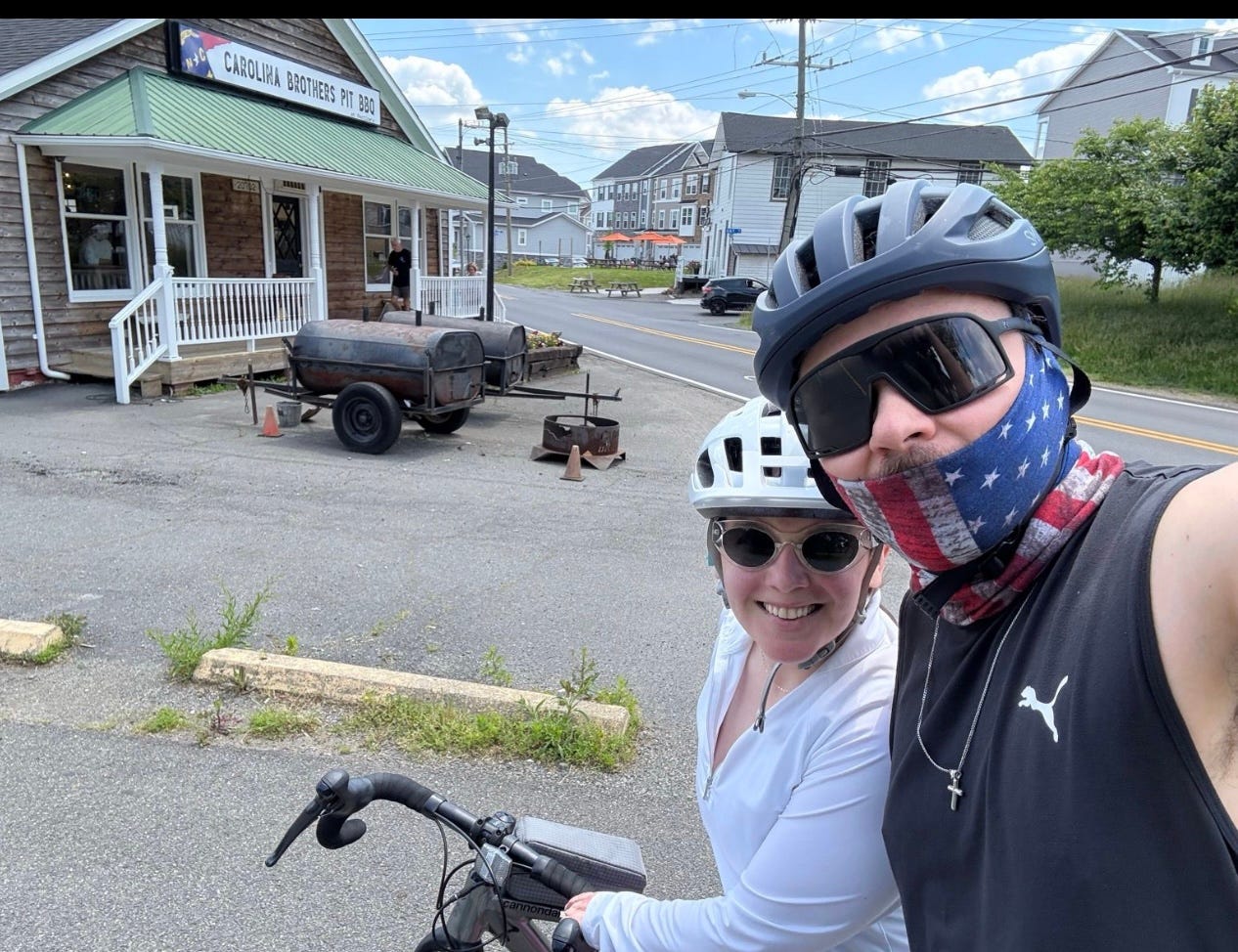
Ashburn, while a great place to live, is testament to how fast a place can change. It became the data center capitol of the world in about 30 years.
And today, it can — and will — happen way faster all over this country.
Developers are looking for cheap land and access to transmission lines in states like Nevada, Arizona, Utah and Wyoming:
Thirsty data centers are sprouting like weeds in parts of the West that are already arid and now gripped by severe drought. In the greater Phoenix area, proposed housing developments have died due to a lack of available groundwater. Yet data centers, each of which can consume an entire sprawling subdivision’s worth, face no such requirements or water restrictions.
High Country News, July 28, 2025
Data centers are popping up around the Midwest. A small town in Missouri was able to reject a data center proposal, for now:
The insatiable demand for computing power has created a land grab in states like Missouri between companies like Google and Meta, which often work in anonymity through brokers like Diode to procure real estate.
The New York Times, October 24, 2024
In West Virginia, a community that attracts tourists for outdoor recreation opportunities is in a battle over a proposed data center that would build its own natural gas plant as well:
Earlier this month, representatives for Fundamental Data — who did not respond to requests for comment on this article — told the Wall Street Journal that the facility could be “among the largest data center campuses in the world,” spanning 10,000 acres across Tucker and Grant counties if fully realized.
West Virginia Watch, May 28, 2025
Back on the bike trail, I get as close as I can to the neighboring data centers. They are mysterious, guarded, and massive from the road, but from the trail, you can get a little closer to sneak a peek through the fence. You can hear the hum from the generators. See the cars in the parking lots of the people who work there. From the road, we lament every new data center going up around us in every open patch of land. But from the bike trail, I take a breath. I gain perspective. I remember that these buildings are making modern life possible, as ugly and overwhelming as they may be.
I don’t think we can stop the onslaught of data centers that this country is about to see. The wheels are in motion and on track to turn even faster. If a bike ride through Ashburn tells you anything, it should be that developers will take every inch of land, resources, and power they can. Hold on tight to what you love in the race toward the future.
Lost & Found
A piece of history:
This weekend, I explored Oatlands, a former plantation built in the early 1800s and is now a national historic landmark in Loudoun County, Virginia. At the start of the Civil War, 133 enslaved people worked and lived at Oatlands.


The Orange Osage tree on the left caught my eye. While this species is not native to Virginia, its origins in the state can be traced back to Lewis & Clark’s tree clippings collected during their travels. The clippings were planted across several places in Virginia after the explorers gave them to Thomas Jefferson.
A quote I loved:
Oatlands was restored after it fell into disrepair around the turn of the century. Edith Eustis said this of her family’s efforts to revitalize it in the early 1900’s:
“It was a thankful task to restore the old beauty, although the thoughts and conceptions were new, they fitted it. And every stone vase or bench, every box-hedge planted, seemed to fall into its rightful place and become part of the whole.”
For awareness:
America’s most endangered historic places list by the National Trust for Historic Preservation
A reason for optimism:
We went to Augusta, Kentucky last winter and I’m itching to go back. On the banks of the Ohio River, Augusta has struggled economically — and still does — but there are plenty of reasons to feel optimistic. If you go: there’s a charming Main Street (with a shop owned by George Clooney’s family members), a distillery making award-winning bourbons, and possibly the best dessert I’ve ever had, the Honey Pie at Beehive Augusta Tavern. I loved how Beehive puts history first with a story of the building’s past at the top of the menu. It was once set on fire during the Civil War while the townspeople were trying to keep the Confederates from crossing the Ohio River.

